
Careers
Careers Education & Guidance Programme
Warblington School is committed to providing our students with a comprehensive programme of Careers Education, Information, Advice and Guidance (CEIAG) and Work Related Learning (WRL) throughout Years 7-11.
Pupil Entitlement
Pupils in Years 8-11 are entitled to:
Find out about technical education qualifications and apprenticeship opportunities, as part of a careers programme which provides information on the full range of education and training options available at each transition point;
Hear from a range of local providers about the opportunities they offer, including technical education and apprenticeships – through course choice evenings, assemblies and group discussions and taster events; Understand how to make applications for the full range of academic and technical courses. Many events, integrated into the school’s careers programme, will offer providers an opportunity to come into college to speak to pupils and/or their parents/carers.
Careers Guidance
1:1 interviews with a qualified Careers Adviser to help you explore careers ideas, address barriers, and gain confidence to plan your next step.
Advice
Your careers adviser will enable you to understand and interpret careers information so that it becomes relevant to your situation.
Support
Ongoing careers coaching sessions with your Careers Adviser will help you complete your skills and job profile assessments, improve confidence, and develop employability skills.
Management of Provider Access Requests
Providers not already working with the school and wishing to request access should contact our career leaders below, or call on 02392 475480.
We are happy to include work with all stakeholders.
Careers Development
We endeavour to work towards the Careers Development Institute Framework for careers, employability and enterprise education 7-19, the DFE Careers guidance and inspiration in schools’ Statutory guidance (July 2021) and other good practice guidance from the Department of Education, Ofsted and other relevant bodies. The school is also working to complete all 8 Gatsby Benchmarks, a sign of excellent CEIAG, as soon as possible.
Careers and work related education is an important part of the wider curriculum that we offer within the school to our pupils.
We believe that every individual should be prepared for the opportunities, responsibilities and experiences of adult life, and that this preparation should be an important and distinctive element of the curriculum.
Our Careers Education Programme provides students with skills, knowledge, support and experience of the world of work to enable them to make informed career choices.
Another important element for our students is the access to independent and impartial advice and guidance, which supports them in broadening their horizons, raising aspirations and reaching their own careers aspirations.
Pupils will be making important pathway and career choices which will ultimately impact on their life. It is essential that parents and carers play an active role in exploring the options and choices which are best for their child.
Apprenticeships
Careers Policy
General Careers
Local Market Information
T Levels
Work Experience
Year 11 Leavers Destinations
Parent/Carer Supporting Your Child Post-16
Colleges, Training Providers, & Open Events
Careers Education & Guidance Programme
Universities
Apprenticeships
An Apprenticeship is a program that trains a worker to become skilled in a particular trade. Apprenticeships combine hands-on work with classroom learning to train the apprentice. Apprenticeships are considered full-time employment. As the apprentice is learning, they are also applying the lessons through working.
Useful sites to visit include:
www.apprenticenation.co.uk – Apprentice Nation’s vision is a Britain where apprenticeships and university are equally valued. Using popular UK artists, they raise awareness of apprenticeships among diverse groups of young people, and provide them with fundamental skills to shape their future.
www.gov.uk/apply-apprenticeships – this site allows you to search all local apprenticeships vacancies from all providers
www.stevewillis.com – are specialists in gas, plumbing and electrical training
www.peta.co.uk – offer apprenticeships in a variety of specialisms including engineering, management, ICT and Business
The following colleges also offer apprenticeships in a number of subjects. Please visit their websites for more information.
General Careers
National Careers Services https://nationalcareers.service.gov.uk/
Royal Navy Careers https://www.royalnavy.mod.uk/careers
Army Careers https://apply.army.mod.uk/roles
TED Talk ‘Fake it till you make it’ https://www.youtube.com/watch?v=RVmMeMcGc0Y
BBC Bitesize Careers https://www.bbc.co.uk/bitesize/careers
Barclays Life Skills https://barclayslifeskills.com/
Career Pilot https://careerpilot.org.uk/
Go Construct – Career Explorer website – build your future as an Architect, carpenter, surveyor, electrician, bricklayer, engineer… https://www.goconstruct.org/
NHS Careers https://www.healthcareers.nhs.uk/we-are-nhs/we-are-nhs
Work Experience
Work experience is an opportunity for young people to gain an insight into the world of work, and to help them prepare for the responsibilities and opportunities of adult life. The school encourages all students to participate in work experience.
These arrangements are under review.
If you know of any local businesses or have connections with any companies that may be able to support any of our pupils with a work experience placement, please email e.payne@warblingtonschool.co.uk.
Local Market Information
Labour Market Information (LMI) is a useful tool to help research future jobs in the local area, understand the skills needed for certain roles and the demand for future employment.
LMI helps to break down the complex ‘world of work’– ranging from descriptions of different careers, their entry routes, promotional prospects, salaries paid, skills and qualifications needed, etc. Crucially for young people, LMI also covers future demand – what kinds of jobs will be in demand after leaving school and what kinds of skills will be needed.
Why is Labour Market Information Important to Young People?
‘It is vital, in an environment where new industries are emerging and many of the most important jobs of the future don’t yet exist, that individuals have access to high-quality labour market information and earnings data to underpin their choices’. Anne Milton MP
LMI can be found at:
www.bbc.co.uk/bitesize/careers
https://www.gov.uk/government/publications/uk-labour-market-projections-2014-to-2024
T Levels
T Levels: What they are
T Levels are courses which follow GCSEs and are equivalent to 3 A levels. These 2-year courses have been developed in collaboration with employers and businesses so that the content meets the needs of industry and prepares students for work, further training or study.
T Levels offer students a mixture of classroom learning and ‘on-the-job’ experience during an industry placement of at least 315 hours (approximately 45 days).
In time, students will be able to take a T Level in the following subject areas:
· accounting
· agriculture, land management and production
· animal care and management
· building services engineering for construction (starting September 2021)
· catering
· craft and design
· design and development for engineering and manufacturing
· design, surveying and planning for construction (now available)
· digital business services (starting September 2021)
· digital production, design and development (now available)
· digital support and services (starting September 2021)
· education and childcare (now available)
· finance
· hair, beauty and aesthetics
· health (starting September 2021)
· healthcare science (starting September 2021)
· human resources
· legal
· maintenance, installation and repair for engineering and manufacturing
· management and administration
· engineering, manufacturing, processing and control
· media, broadcast and production
· onsite construction (starting September 2021)
· science (starting September 2021)
How T Levels will work with other qualifications
T Levels will become one of the main choices for students after GCSE alongside:
· apprenticeships for students who wish to learn a specific occupation ‘on the job’
· A levels for students who wish to continue academic education
We are currently reviewing post-GCSE qualifications to create a simpler, high-quality system that students, parents and employers will all understand.
T Levels are based on the same standards as apprenticeships, designed by employers and approved by the Institute for Apprenticeships and Technical Education (the Institute). We expect the total time for a T Level to be around 1,800 hours over the 2 years, including the industry placement. This is a significant increase on most current technical education courses.
This differs from an apprenticeship, which is typically 80% on-the-job and 20% in the classroom and is more suited to those who know what occupation they want to pursue, want to earn a wage and learn at the same time and are ready to enter the workforce at age 16.
How T Levels have been developed
Employers and providers have been working together to develop each T Level, with support from DfE and the Institute. Groups of employers have defined the skills and requirements for each T Level course by participating in T Level panels. This ensures that students taking T Levels will develop the technical knowledge and skills required by employers in that industry.
The T Level panels have developed the content for the qualification, based on the same standards as apprenticeships and these plans are then tested and reviewed with students, education providers and employers.
The technical qualifications for the first 3 T Levels have now been approved by the Institute and accredited by Ofqual for teaching from September 2020. These are in:
· design, surveying and planning for construction
· digital production, design and development
· education and childcare
Structure of a T Level
T Level courses include the following compulsory elements:
· a technical qualification, which includes:
· core theory, concepts and skills for an industry area
· specialist skills and knowledge for an occupation or career
· an industry placement with an employer
· a minimum standard in maths and English if students have not already achieved them
Industry placements
Every T Level includes an industry placement with an employer focused on developing the practical and technical skills required for the occupation. These will last a minimum of 315 hours (approximately 45 days) but can last longer. Employers can offer industry placements as a block, day release or a mix of these, and can discuss sharing part of the placement with another employer if necessary.
Providers will support employers offering industry placements. This will include assistance with the necessary paperwork, a careful planning process and support with designing the industry placement.
The Education and Skills Funding Agency (ESFA) and National Apprenticeship Service (part of ESFA) are working with employers and providers on industry placements.
Employers interested in finding out more about industry placements can contact 08000 150 600, email tlevel.placement@education.gov.uk or visit the employer section of the T Levels website.
Grading and certification
Students who complete their T Level will receive an overall grade of pass, merit, distinction or distinction*. They will get a nationally recognised certificate which will show their overall grade and a breakdown of what they have achieved.
The T Level certificate will include:
· an overall grade for the T Level, shown as pass, merit, distinction or distinction*
· a separate grade for the core component, using A* to E
· a separate grade for each occupational specialism, shown as pass, merit or distinction
It will also include confirmation that the student has:
· met the minimum requirements for maths and English qualifications
· completed the industry placement
· met any additional mandatory requirements
A student’s overall T Level grade will be worked out from the grades they achieved on the core component and the occupational specialism(s).
Students who do not pass all elements of their T Level will get a T Level statement of achievement which will show the elements they have completed.
UCAS tariff points
T Levels will provide several progression options to students. These include skilled employment, an apprenticeship and higher education.
To help T Level students get into higher education, UCAS tariff points will be allocated to T Levels.
UCAS points will only be allocated to the overall T Level grade. Students must achieve at least an overall pass grade to receive UCAS points.
|
UCAS tariff points |
T Level overall grade |
A level |
|
168 |
Distinction* (A* on the core and distinction in the occupational specialism) |
AAA* |
|
144 |
Distinction |
AAA |
|
120 |
Merit |
BBB |
|
96 |
Pass (C or above on the core) |
CCC |
|
72 |
Pass (D or E on the core) |
DDD |
Information & Resources about T Levels
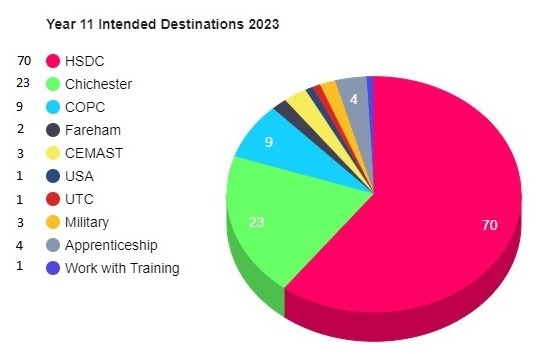
Year 11 Leavers Destinations
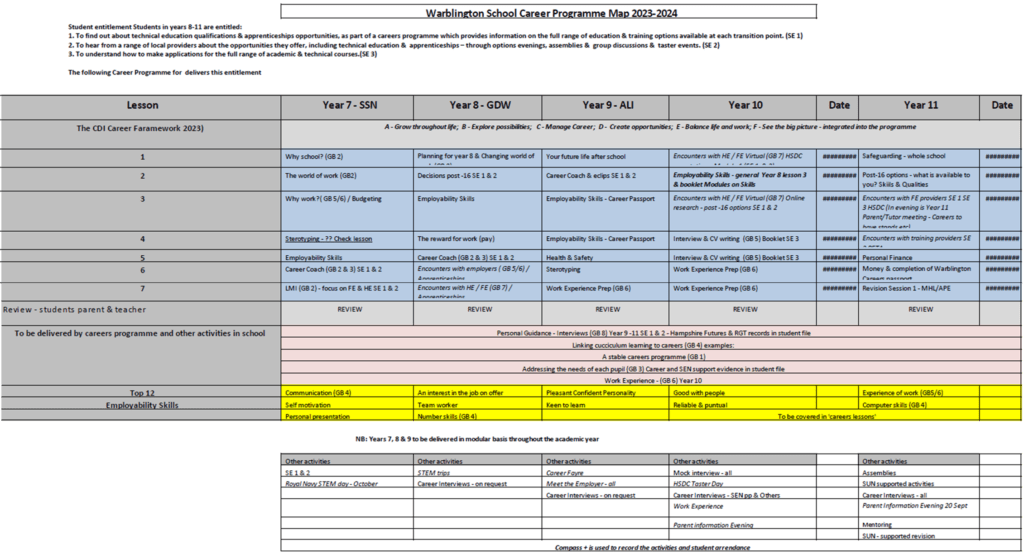
Careers Education & Guidance Programme
Careers Policies
Careers Education and Guidance Policy
Provider Access Statement
Colleges, Training Providers, & Open Events
Thinking about life after school?
Hampshire County Council have developed a website with a whole host of information on education, training and local youth support: www.hants.gov.uk/yourfuture
If you would like information on any courses or training providers please click on the links below:
www.oaklandscatholicschool.org
Supporting your Child Post-16
https://careerpilot.org.uk/At Warblington school, we understand how daunting it can be to help your child make an informed decision about their future. Therefore, supporting you as well as the students, through this period of time, is important to us.
Understanding the options available can support you and help you feel confident in the support that you give. All children in the UK must remain in education or training until at least their 18th birthday.
This could include:
• A full-time place at a Sixth Form or College
• An apprenticeship
• A recognised training scheme such as the Armed Forces
• A part-time job or volunteering, combined with a recognised National qualification.
Once you have supported your child to understand whether the more academic pathway of A-levels, or the more skills or work-based vocational pathway is best, the next thing to consider is the learning environment, as this will have a bearing on your child’s enjoyment and progress post-16 education.
School Sixth Form:
It is more structured and centred around the school routine (although more independent learning than in previous years). It is more classroom-based learning, with support for learning and pastoral matters. May or may not wear a uniform.
College:
There is greater independence from the start, choose where to spend free lessons, less structure. Less obvious support but accessible when sought. No uniform. (Please look at the College/training section providers for useful links.) BTECs are very flexible vocational qualifications. They can be studied at various levels, each of which equates to a different qualification.BTEC Level 1 and 2 – equivalent to GCSEs BTEC Level 3 = equivalent to A-levels BTEC Level 4-5 = equivalent to 1st and 2nd year of an undergraduate degree.
Apprenticeship:
On an apprenticeship, you are both employed to do a real job whilst also studying for a formal qualification, either in a training centre or a college. You are an employee with a contract of employment and holiday leave. (Please look at the Apprenticeship section for useful links.)
T Levels:
T Levels are new courses which follow GCSEs and are equivalent to 3 A levels. These 2-year courses, which launched in September 2020, have been developed in collaboration with employers and businesses so that the content meets the needs of the industry and prepares students for work, further training or study. T Levels offer students a mixture of classroom learning and ‘on-the-job’ experience during an industry placement of at least 315 hours (approximately 45 days).
www.talkingfutures.org.uk is a resource designed to help parents/carers have informed conversations with their child about what type of training and education pathways are available to them. Careermag is a great place to get a full rundown on Apprenticeships, Careers of the future and how to talk to your teenager about Careers.
Please follow this link: resources.careersandenterprise.co.uk/
All the information and tools you need to explore your future career.
https://nationalcareers.service.gov.uk/
https://www.lmiforall.org.uk/skillsometer/
https://azspeakerseries.internationalschoolspartnership.com/
Universities
The Southern Universities Network (SUN) is a collaborative partnership comprising HE providers in Hampshire, Dorset and the Isle of Wight. The SUN provides outreach activities for schools and colleges as part of Uni Connect – an Office for Students (OfS) – funded project. The SUN has been tasked with increasing HE participation in over 70 wards, working with 137 schools and all further education (FE) colleges in the region. As directed in OfS guidance, work will be focused on young people in Years 9 – 13 and their ‘key influencers.’
Please follow the link for more information on:
• Find and Compare the Best University & Degree Courses – The Uni Guide: www.thecompleteuniversityguide.co.uk
https://universitycompare.com/courses/degrees
Students and parents can find it difficult to get to grips with Student Finance, there is a handy guide on the following link:
https://www.savethestudent.org